
The Health Disparities Podcast is the world’s leading health equity discussion forum and is a program of Movement is Life. This podcast features thought leaders in the world of equitable health, and highlights health disparities, social determinants of health and community-led solutions.
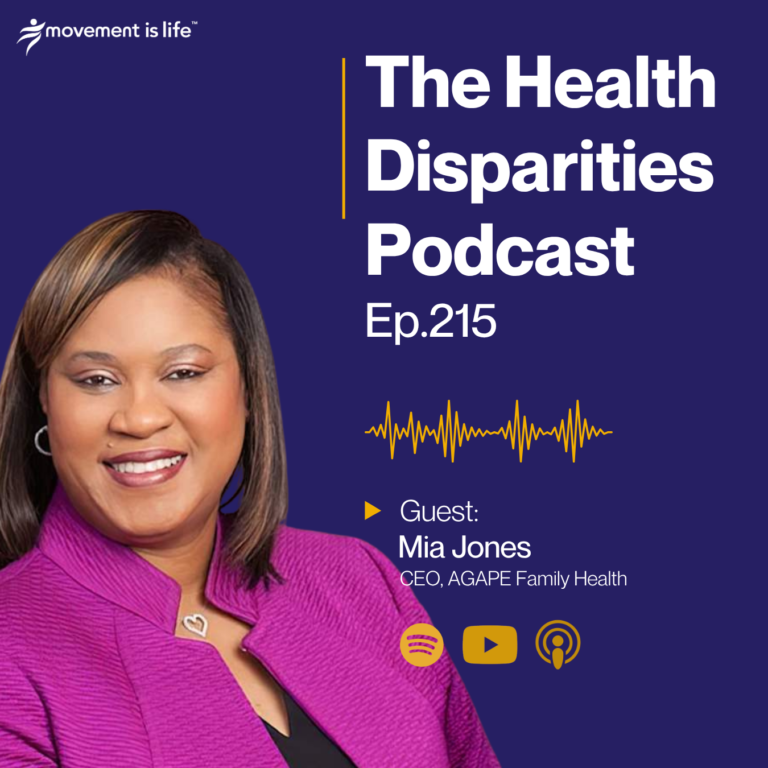
In this episode of The Health Disparities Podcast, host Joyce Knestrick sits down with Mia L. Jones, Chief Executive Officer of Agape Family Health, a community‑rooted health system serving Jacksonville with comprehensive medical, pharmaceutical, and behavioral health services.
Agape’s mission is simple and powerful: “everyone deserves quality, affordable care delivered with compassion, regardless of insurance status or ability to pay.” Mia shares the experiences that shaped her path to leadership and the values that fuel her commitment to community‑centered care. She discusses the gaps she saw when stepping into her role and how Agape works every day to remove barriers to access—from sliding‑scale payment options to neighborhood‑based clinics across Jacksonville.
Together, Joyce and Mia explore:
- What a new patient experiences when accessing Agape’s family practice, women’s health, pharmacy, and behavioral health services
- How integrating medical, pharmaceutical, and behavioral health improves outcomes for patients managing chronic conditions
- The importance of trust, dignity, and compassionate care for patients who have faced dismissive or negative healthcare experiences
- Jacksonville’s legacy of community‑based care—from Brewster Hospital to Dr. Alexander Darnes—and how that history shapes Agape’s mission today
- Real‑world inequities such as transportation, insurance gaps, chronic disease burdens, and mistrust in the healthcare system
- The partnerships, funding challenges, and operational realities of sustaining a mission‑driven nonprofit health system
Mia also shares powerful stories of impact—moments when Agape’s care changed the trajectory of someone’s life—and offers practical advice for clinicians and listeners who want to support health equity in their own communities.
This episode is essential listening for anyone working in community health, public health, philanthropy, health equity, or systems‑level change.
Subscribe for more conversations about community‑driven solutions, health equity, and the work to eliminate disparities.
The Health Disparities Podcast is the world’s leading health equity discussion forum and is a program of Movement is Life. This podcast features thought leaders in the world of equitable health, and highlights health disparities, social determinants of health and community-led solutions.
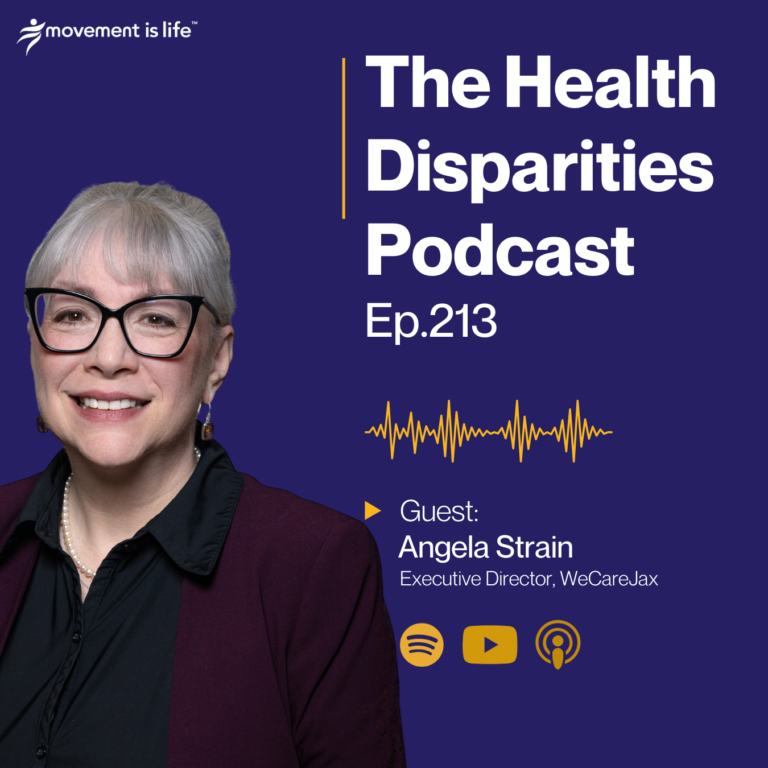
In this episode of The Health Disparities Podcast, host Dr. Mary O’Connor talks with Angela Strain, Executive Director of We Care Jax. For over 30 years, this organization has connected uninsured and under-resourced neighbors to lifesaving specialty care.
Angela shares powerful patient stories and draws on years of experience to show what it takes to remove barriers, build trust, and create a safety net that truly helps people. She explains real-world obstacles like transportation, language barriers, and the financial burden of illness, and highlights community-driven solutions that help people get the care they need.
Angela and Dr. O’Connor discuss We Care Jax’s approach and share stories from the patients they serve, exploring topics such as:
- Community health workers use persistence, trust, and cultural insight to uncover the real reasons behind missed appointments or labels like “non‑compliant.”
- Common specialty needs include cardiology, pulmonology, oncology, and advanced imaging, supported by a network of volunteer physicians.
- Transportation support, hotel stays, translation services, and food access function as essential parts of healthcare, not optional add‑ons.
- Florida’s expansion of the Volunteer Provider Program and the urgent need for increased dental funding are highlighted as key policy issues.
- Peer‑to‑peer physician recruitment, strong hospital partnerships, and donor investment help sustain a model rooted in community trust.
Angela also talks about the heart of her work: making sure every patient leaves with no medical debt, their dignity intact, and a real chance to heal. Her stories, including patients moving from homelessness to stable housing and from fear to treatment, show why compassionate, community-centered care is so important.
This episode is full of stories and insights for anyone working in health equity, community health, philanthropy, public health, or systems change.
Subscribe to hear more conversations about community-driven solutions, health equity, and efforts to eliminate disparities.
The Health Disparities Podcast is the world’s leading health equity discussion forum and is a program of Movement is Life. This podcast features thought leaders in the world of equitable health, and highlights health disparities, social determinants of health and community-led solutions.
What would it take for health care providers to truly meet people where they are – and go beyond the 15-minute visit?
Dr. Razia Jayman-Aristide is a physician who blends deep clinical expertise with a powerful public health lens. She has spent the last 15 years building a career that bridges direct patient care, nonprofit leadership and systemic change.
In this episode, Dr. Jayman-Aristide shares her journey — and how she’s redefining what medicine, emphasizing the need for personalized care that addresses social determinants of health.
“My family was a family that came here with minimal in their pocket. We were getting food stamps. We were on WIC lines. I was going to the FQHC clinics,” she says. “I would see parents losing, you know, a day of the salary just to get me health care. It’s crazy that we don’t think about those things. And I bring that everywhere I go.”
Registration is now open for the upcoming Movement Is Life Annual Summit on Friday, November 14, 2025, in Washington, DC. This year’s theme is “Combating Health Disparities: The Power of Movement in Community.” Visit movementislifecommunity.org for more information.
Never miss an episode – subscribe to The Health Disparities podcast from Movement Is Life on Apple Podcasts, YouTube, or wherever you get your podcasts
The Health Disparities Podcast is the world’s leading health equity discussion forum and is a program of Movement is Life. This podcast features thought leaders in the world of equitable health, and highlights health disparities, social determinants of health and community-led solutions.
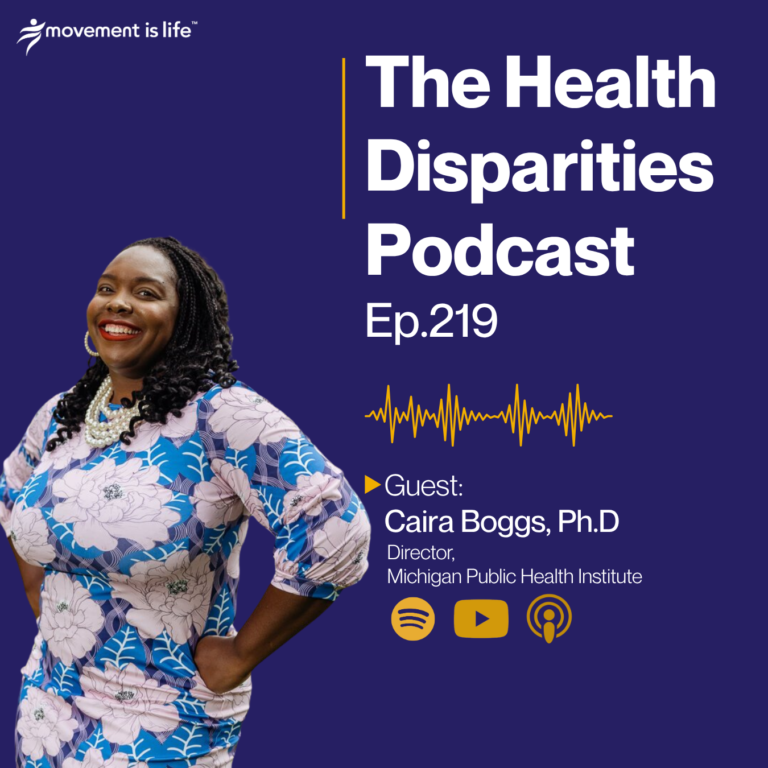
In this episode of The Health Disparities Podcast, host Ber‑Henda Williams sits down with Dr. Caira Boggs, Director of the Michigan Public Health Institute’s Center for Health Innovation and Practice and Detroit Health Initiatives. A proud Detroit native and Detroit Public Schools graduate, Dr. Boggs leads 16 initiatives focused on health equity, recovery, food access, chronic disease prevention, and community‑led grantmaking — all grounded in the lived experiences of Detroit neighborhoods.
Dr. Boggs shares the early moments that shaped her understanding of inequity, from growing up in a deeply connected Detroit community to witnessing stark disparities when she left home for college. Her path from kinesiology and pre‑med to public health leadership was fueled by a desire to advocate for people who look like her — especially after learning how maternal and infant health outcomes disproportionately impact Black women, regardless of income or education.
Together, Ber‑Henda and Dr. Boggs explore:
- What resilience looks like in Detroit neighborhoods, where communities “keep going, keep moving, no matter what,” despite redlining, food insecurity, and structural barriers.
- How Detroit schools and neighborhood roots shaped Dr. Caira’s public health lens.
- Worker health realities in Detroit’s plants — from blood pressure to chronic disease risks.
- What recovery‑friendly workplaces need: Narcan access, dignity, and long‑term support.
- Food insecurity as both structural and neighbor‑to‑neighbor — and how small acts help.
- Neighborhood‑driven solutions like micro‑grants, walking clubs, and anchor organizations.
- How COVID‑19 exposed inequities and elevated social determinants of health.
Dr. Boggs also reflects on the personal experiences that continue to motivate her — from loved ones whose health outcomes could have been different with better access, to the collective trauma and awakening brought on by the pandemic. Her message is clear: every person has the power to change someone’s trajectory, whether through advocacy, compassion, or simply knowing the people on your block.
This episode is essential listening for anyone working in community health, public health, philanthropy, health equity, or systems‑level change — and for anyone who believes in the strength and brilliance of Detroit’s neighborhoods.
The Health Disparities Podcast is the world’s leading health equity discussion forum and is a program of Movement is Life. This podcast features thought leaders in the world of equitable health, and highlights health disparities, social determinants of health and community-led solutions.
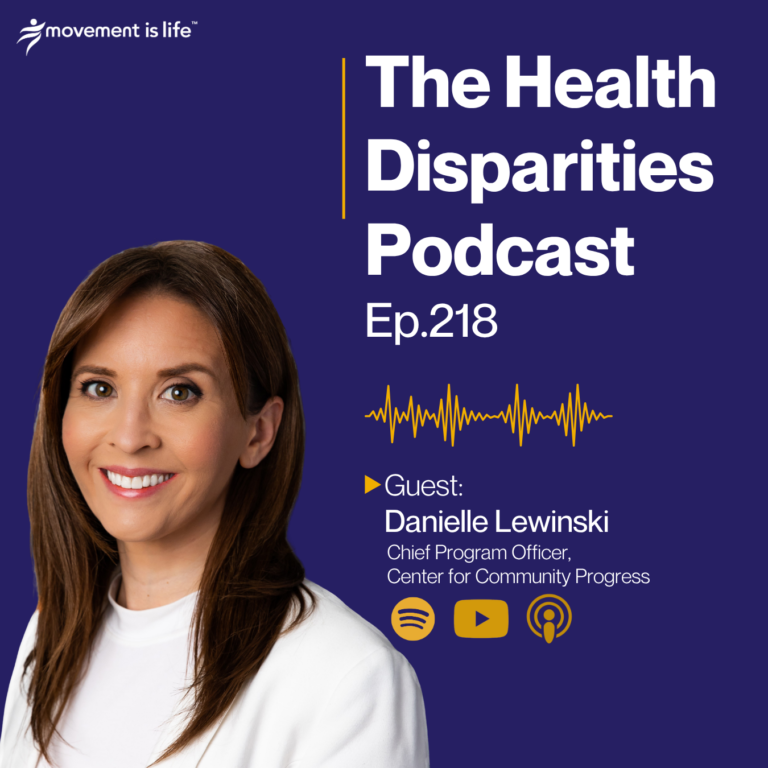
In this episode of The Health Disparities Podcast, host Michael Randall talks with Danielle Lewinski, Chief Program Officer at the Center for Community Progress, about how vacant properties, neighborhood conditions, and public policy directly shape health outcomes.
Danielle breaks down why the U.S. has millions of vacant and substandard homes and how these conditions fuel chronic disease, mobility challenges, safety concerns, and long‑term disinvestment. She explains how public policy, code enforcement, tax foreclosure systems, and land banks can either reinforce inequity or create pathways to healthier, thriving communities.
You’ll learn about:
- How vacant properties harm health
- Why policy change is essential for neighborhood recovery
- How vacancy affects mobility and safety
- Green reuse strategies that improve community wellbeing
- The most damaging myths about vacancy
- Upstream vs. reactive systems in property revitalization
Perfect for viewers interested in health equity, urban policy, community development, mobility justice, and place‑based public health.
The Health Disparities Podcast is the world’s leading health equity discussion forum and is a program of Movement is Life. This podcast features thought leaders in the world of equitable health, and highlights health disparities, social determinants of health and community-led solutions.
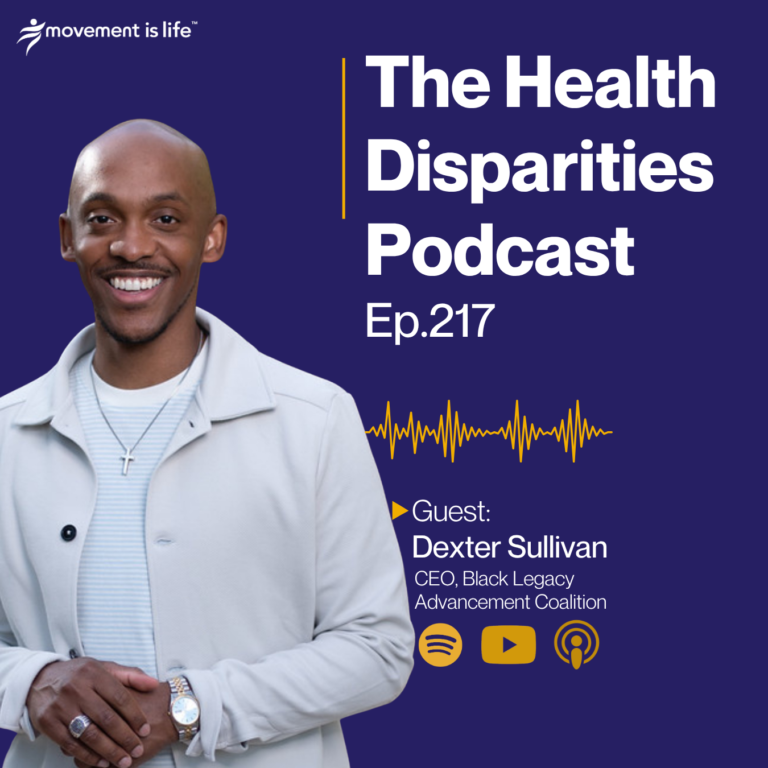
In this episode of The Health Disparities Podcast, host Ber‑Henda Williams sits down with Dexter Sullivan—global strategist, community builder, and CEO of the Black Legacy Advancement Coalition. Dexter opens up about his Detroit roots, the generational stories that shaped him, and the urgent work of preserving Black legacy as a pathway to better health and stronger communities.
He reflects on the influence of his grandparents, the educators who nurtured his identity, and the cultural traditions that continue to guide his leadership. Dexter also discusses the emotional realities Black men face, the importance of remembrance in community healing, and how culturally aligned approaches can transform health outcomes.
You’ll hear insights on:
- How legacy preservation strengthens community health
- The role of Detroit’s cultural lineage in shaping identity
- Why policy rollbacks threaten social determinants of health
- Supporting Black men through grief and emotional processing
- Culturally rooted “couture solutions” in health equity work
- The power of gathering, food, and the table as healing spaces
This conversation is a must‑listen for anyone working in health equity, community leadership, Black mental health, public health, or culturally responsive care. It’s a grounding, heart‑centered reminder that love, memory, and community are essential parts of the health ecosystem.
The Health Disparities Podcast is the world’s leading health equity discussion forum and is a program of Movement is Life. This podcast features thought leaders in the world of equitable health, and highlights health disparities, social determinants of health and community-led solutions.
In this episode of The Health Disparities Podcast, host Ber‑Henda Williams sits down with Dr. Caira Boggs, Director of the Michigan Public Health Institute’s Center for Health Innovation and Practice and Detroit Health Initiatives. A proud Detroit native and Detroit Public Schools graduate, Dr. Boggs leads 16 initiatives focused on health equity, recovery, food access, chronic disease prevention, and community‑led grantmaking — all grounded in the lived experiences of Detroit neighborhoods.
Dr. Boggs shares the early moments that shaped her understanding of inequity, from growing up in a deeply connected Detroit community to witnessing stark disparities when she left home for college. Her path from kinesiology and pre‑med to public health leadership was fueled by a desire to advocate for people who look like her — especially after learning how maternal and infant health outcomes disproportionately impact Black women, regardless of income or education.
Together, Ber‑Henda and Dr. Boggs explore:
- What resilience looks like in Detroit neighborhoods, where communities “keep going, keep moving, no matter what,” despite redlining, food insecurity, and structural barriers.
- How Detroit schools and neighborhood roots shaped Dr. Caira’s public health lens.
- Worker health realities in Detroit’s plants — from blood pressure to chronic disease risks.
- What recovery‑friendly workplaces need: Narcan access, dignity, and long‑term support.
- Food insecurity as both structural and neighbor‑to‑neighbor — and how small acts help.
- Neighborhood‑driven solutions like micro‑grants, walking clubs, and anchor organizations.
- How COVID‑19 exposed inequities and elevated social determinants of health.
Dr. Boggs also reflects on the personal experiences that continue to motivate her — from loved ones whose health outcomes could have been different with better access, to the collective trauma and awakening brought on by the pandemic. Her message is clear: every person has the power to change someone’s trajectory, whether through advocacy, compassion, or simply knowing the people on your block.
This episode is essential listening for anyone working in community health, public health, philanthropy, health equity, or systems‑level change — and for anyone who believes in the strength and brilliance of Detroit’s neighborhoods.